Industrial development drives economic development. To some extent, the generation of industrial wastewater is inevitable. However, with the rapid increase in the types and quantities of wastewater, water pollution has become increasingly widespread and serious, and industrial wastewater management is imperative. New ideas are opened up for enterprises to solve wastewater problems, from industrial wastewater treatment processes to common processes.
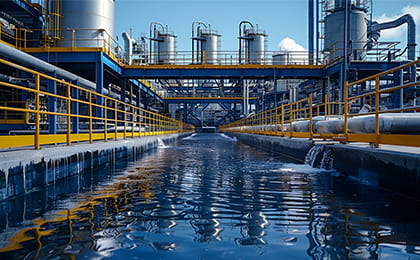
1. What is the industrial wastewater treatment process generated in industrial development?
1. Collection of raw wastewater
First, industrial wastewater that needs to be treated for subsequent treatment must be collected.
2. Chemical pretreatment
Before leaving the factory, chemical pretreatment is carried out using chemical agents and technologies to condense, scum, and precipitate suspended matter, oil pollution, and other substances to achieve the effect of reducing load and removing toxic and harmful substances.
3. Biological treatment
After the wastewater is pretreated, biological treatment technology is used to use anaerobic aeration tanks, anaerobic tanks, biological filters, and other methods to use the original microorganisms in the wastewater to decompose, adsorb, exchange, oxidize and other substances such as suspended matter, oil pollution, etc., to achieve the purpose of industrial wastewater treatment and purification.
4. Preliminary treatment of purified water
After biological treatment, the industrial wastewater is further purified, and sometimes activated carbon adsorption, electrophoresis decolorization, and other technologies are used to reduce the content of residual toxins and organic matter.
5. Final treatment of water purification
The final industrial wastewater treatment can use sedimentation, filtration, filter tanks, ion exchange, activated carbon adsorption, membrane separation, and other technologies to remove and purify harmful substances in industrial wastewater.
2. Four common industrial wastewater treatment processes
1. Reverse osmosis technology
This technology has high efficiency, low investment cost, simple operation, and does not require too complicated processes. The specific requirements for the process environment are not high, and it only needs to be operated at normal temperature. Because of the many advantages of reverse osmosis technology, it is widely used in industrial wastewater treatment. Reverse osmosis technology has a wide range of applications. From the initial seawater desalination to the later light industry and medical fields, the use of this method can be seen, and it has extremely high economic value.
2. Ion exchange resin technology
This technology is also an emerging industrial sewage treatment method in recent years. Its remarkable feature is that it can treat heavy metals in sewage well. Ion exchange resin will not mix with any acid or alkaline solution and can completely filter heavy metals from acidic and alkaline wastewater. The filtered sewage must also be treated with sodium sulfide to meet the compliance discharge standards. This technology applies chemical principles and is extremely targeted. After being treated with this technology, the sewage can be recycled again. Recycling it as cooling water effectively improves water quality and resource utilization.
3. Biological treatment technology
When we treat sewage, we have to deal with visible impurities and some invisible organisms and microorganisms. Therefore, many companies use biological treatment technology for industrial wastewater treatment.
4. Membrane separation technology
A new separation technology uses the difference in selective permeability of each component in the mixture to separate, purify, and concentrate the target substance.
Commonly used membrane technologies include ultrafiltration, microfiltration, electrodialysis, and reverse osmosis. Ultrafiltration and microfiltration cannot effectively remove salt in sewage when used to treat industrial wastewater, but they can effectively intercept suspended solids and colloidal COD; electrodialysis and reverse osmosis technology are the most effective and commonly used desalination technologies.