1. Low pH will seriously affect sewage and reinforced concrete structures; 2. Cr3 + can induce lung cancer; 3. Fluorine and nickel can also affect cell metabolism disorders, and so on. The traditional treatment of stainless steel surface pickling wastewater is mainly through chemical precipitation, physical adsorption, and other methods. At present, this method also involves the separation and treatment of heavy metals such as chromium and nickel. Then, the sludge is unified to achieve the removal effect.
In this program design, there are four main points:
- Because it is a combination of industrial wastewater and domestic wastewater together, the wastewater contains a certain concentration of COD, the value of which is about 100-200mg / L. Because the wastewater is partially reused and discharged, then the quality of the effluent water is relatively high, and it is necessary to carry out further degradation of COD in the water;
- At the same time, wastewater contains chromium. Nickel heavy metals also need to be further removed in the wastewater contains a certain amount of Cr6+ due to the toxicity of Cr6+ being much stronger than Cr3+, so in the general treatment process, the need to degrade Cr6+ into Cr3+, to reduce its toxicity;
- The wastewater's pH reaches 2-5, which is relatively low and is unfavorable for the subsequent effect of the treatment process; need to adjust the pH;
- Cr3+, Ni2+, and other metals need to be removed before wastewater can be directly discharged and reused.
Selection of wastewater treatment process
(1) Fenton reaction has a strong oxidizing ability; its oxidation potential is second only to fluorine, as high as 2.80V; in addition, the hydroxyl radical has a high electronegativity or electrophilicity, and its electron affinity capacity reaches 569.3kJ. It has a strong additive reaction characteristic. Thus, the Fenton reagent can oxidize most of the organic matter in the water without selective oxidation and is especially suitable for the oxidation treatment of organic wastewater that is difficult to degrade by biological organisms or generally difficult to oxidize by chemical oxidation. It is especially suitable for the oxidation treatment of organic wastewater, which is difficult to degrade biologically or oxidize chemically, and is widely used in the treatment of printing and dyeing wastewater, oil-containing wastewater, phenol-containing wastewater, coking wastewater, nitrobenzene-containing wastewater, aniline-containing wastewater and other wastewaters.
(2) Inclined plate sedimentation tank
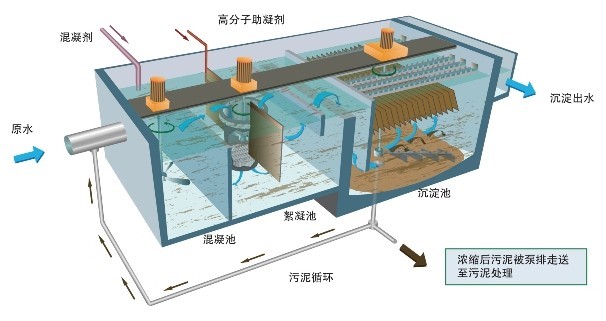
Wastewater enters the tank from the inlet pipe, flows downward through the inlet chamber in the middle of the tank, is reflected by the deflector plate, and then enters the inclined plate through the inlet water distribution port inside. As the solution flows upward, the solid particles settle on the parallel inclined plate assembly and then slide into the sludge hopper at the bottom of the pool body, where the sludge is thickened and discharged through the sludge outlet. The clarified liquid leaves the inclined plate and flows out through the outlet access holes at the top, and then collects through the adjustable outlet weir flow and flows out from the outlet pipe. The purpose of designing the access holes at the top of the inclined plate is to form a pressure difference when the clarified liquid passes through the collecting channel to ensure a uniform distribution of the flow pattern among the inclined plates so that the whole area is utilized. This increases the reliability of the operation, reduces the influence of the solution flow pattern, and reduces the possibility of scaling and siltation.
The inclined plate sedimentation tank's main features
(1) Increase sedimentation capacity: a) Sedimentation area increases. b) Inclined plates can be re-coagulated sediments so that flocs increase and settle easily. c) Inclined plate sedimentation creates laminar flow conditions and a good sedimentation effect.
(2) The concentration of sinking sludge increases.
(3) The amount of discharged clear water remains stable, and no sludge is covered.
(4) Reverse osmosis membrane reactor:
The reverse osmosis membrane is the core element to realize reverse osmosis; it is a simulation of a biological semi-permeable membrane made of an artificial semi-permeable membrane with certain characteristics and generally made of polymer materials, such as cellulose acetate, aromatic polyhydrazide, and aromatic polyamide membranes. The diameter of the surface micropores is generally between 0.5 and 10nm, and the size of the permeability is related to the chemical structure of the membrane itself. Some polymer materials have good salt rejection, while the water transmission rate is not good. Some polymer materials have more hydrophilic groups in their chemical structure, so the water transmission rate is relatively fast. Therefore, a satisfactory reverse osmosis membrane should have an appropriate permeation or desalination rate.
Reverse osmosis membrane should have the following characteristics:
(1) in the high flow rate should have a high-efficiency desalination rate; (2) with high mechanical strength and service life; (3) can play a function in the lower operating pressure; (4) can withstand the chemical or biochemical effects; (5) by the pH value, temperature and other factors have less influence; (6) the membrane raw material source is easy, simple processing, low cost.
There are two types of reverse osmosis membrane structures: asymmetric and homogeneous. Currently, used membrane materials are mainly cellulose acetate and aromatic polyamides. The membrane's components are hollow fiber, roll, plate, frame, and tube. It can be used for separation, concentration, purification, and other chemical unit operations. It is mainly used in pure water preparation and the water treatment industry.
The principle is reverse osmosis, also known as reverse osmosis, a type of membrane separation operation in which a pressure difference is used as the driving force to separate a solvent from a solution. Apply pressure to the material on one side of the membrane; when the pressure exceeds its osmotic pressure, the solvent will reverse osmosis against the direction of natural osmosis. Thus, the low-pressure side of the membrane gets through the solvent, that is, permeate; the high-pressure side gets the concentrated solution, that is, concentrate. If you use reverse osmosis to treat seawater, the low-pressure side of the membrane to get fresh water, and the high-pressure side to get brine. In reverse osmosis, the solvent permeation rate that the energy of the liquid flow N is: N = Kh (Δp - Δπ) where Kh is the hydraulic permeability coefficient, which increases slightly with temperature; Δp is the static pressure difference between the two sides of the membrane; Δπ is the osmotic pressure difference between the two sides of the membrane of the solution. The osmotic pressure π of a dilute solution is π = iCRT, where i is the number of ions generated by the ionization of solute molecules; C is the molar concentration of the solute; R is the molar gas constant; T is the absolute temperature. Reverse osmosis usually uses asymmetric and composite membranes. The equipment used for reverse osmosis is mainly hollow fiber-type or roll-type membrane separation equipment. Reverse osmosis membrane can intercept a variety of inorganic ions, colloidal substances, and macromolecular solutes in water to obtain clean water. It can also be used for the pre-concentration of macromolecular organic solutions. Because the reverse osmosis process is simple and has low energy consumption, nearly 20 years have developed rapidly. Now, large-scale application in seawater and brackish water (see brine) desalination, boiler water softening, and wastewater treatment, and with the combination of ion exchange to obtain high-purity water, its application is expanding, has begun to be used for dairy products, fruit juice concentration and biochemical and biological agents of separation and concentration.
Description of wastewater treatment process and structures
- Wastewater flows through the grating after the respective collection pool, and some larger SS in the wastewater are intercepted and removed through the physical blocking effect of the grating;
- After the role of the grille, the wastewater from the retention into the regulating pool, in the regulating pool under the action of the pusher, the wastewater water quality and water quantity regulation;
- After entering the regulating pool, wastewater in the lifting pump under the lifting effect, wastewater into the H2O2 reaction pool, in the pool add H2O2, redox reaction, while reducing COD;
- Wastewater into the CaO reaction pool, wastewater pH adjustment as well as precipitation reaction, theoretically, in the pH greater than 5, wastewater in the soluble heavy metal ions can be completely precipitated;
- Because part of the nickel hydroxide precipitate may be precipitated in the form of colloidal substances, it is necessary to enter the next process after the flocculation reaction;
- After the reaction of the previous process, the wastewater enters the inclined plate sedimentation tank for physical sedimentation and requires sludge removal measures;
- After the wastewater has been precipitated, an intermediate buffer tank is required due to the possibility of incomplete precipitation and as an influent catchment for subsequent processes;
- After the wastewater passes through the intermediate buffer drum, the wastewater enters the security filter to provide security for the subsequent membrane treatment;
- As the entire wastewater treatment plays a security gatekeeper role, wastewater needs to be processed by the reverse osmosis membrane to achieve partial reuse and partial discharge standards, while the reverse osmosis membrane produces backwash concentrated water discharged into the regulating pool for flocculation and sedimentation again;
- The sludge produced in the inclined plate sedimentation tank is precipitated in the sludge thickening tank and then pumped by a pneumatic diaphragm pump into the plate and frame filter press to carry out filtration. At the same time, the filtrate and the supernatant are re-discharged into the regulating tank.