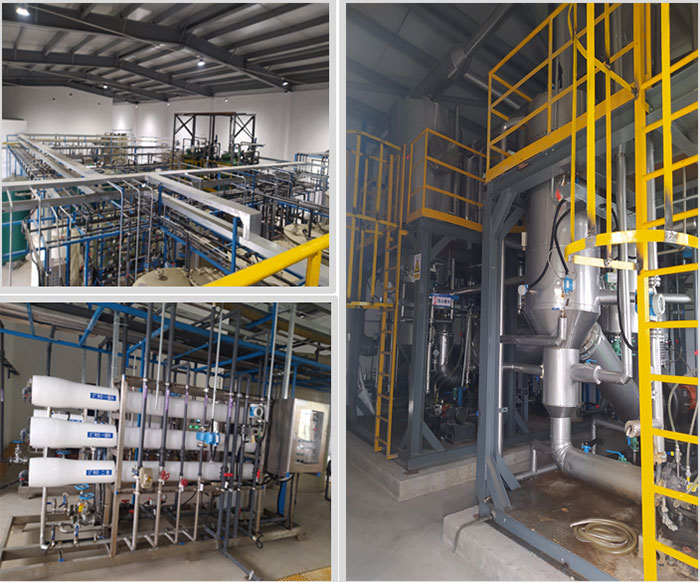
Negative electrode materials account for about 14% of the total cost and include artificial and natural graphite.
The electrolyte accounts for about 13% of the total cost, and its main components are solutes, solvents, and additives. The main cost sources include LiPF6 and the new lithium salt LiFSI.
Lithium is electrolytic copper foil, which accounts for approximately 8% of the cost. It is used for lithium anode collectors.
Diaphragm accounts for 4% of the total material cost.
Lithium wastewater resourcing technology.
1. Pain points of the traditional process Pre-treatment: a large amount of medicine, high cost;
Low concentration multiplication: low efficiency, large amount of water into the subsequent process section;
Evaporation crystallization: large treatment volume, high investment & energy consumption.
2. Thinking about the lithium wastewater resources.
The scope of resourcefulness: not only the reuse of water but also the efficient recovery of high-value materials in wastewater;
Selection of chemicals: add as few chemicals as possible, considering the introduction of impurities will affect the balance of the whole system;
Treatment of sludge: sludge can be generated, but only if it is either in small quantities or of high value;
System reliability: In multi-stage synergistic treatment, the former section's effect often determines the latter process's stability.
3. Selection of pre-treatment process section
Take "special inorganic membrane” as the pre-treatment process section.
Recovery of materials: nickel, cobalt, and manganese metal oxides in the ternary cathode materials have an average particle size of about 1-2μm, and the content in wastewater is 2000-8000mg/L on average;
Removal of heavy metals: nickel removal from ternary anode wastewater, iron removal from lithium iron phosphate wastewater, etc;
Removal of pollutants: removal of magnesium ions, phosphate, etc;
Durability: can be repeatedly strong acid and alkali for chemical cleaning.
Process shortening: replaces flocculation and precipitation, sand and carbon, ultrafiltration, and other process sections;
Reduced dosage: solid-liquid separation can be carried out directly without sedimentation, with low operating cost.
4. Selection of high-fold concentration process section
Take "ZDRO” as the process section of high-fold concentration
Strong anti-pollution: high COD of feed water;

Membrane flow channel width: about 2mm flow channel;
High concentration ratio: up to 20% (in sodium sulfate).
(in terms of sodium sulfate)
Low energy consumption: energy consumption per ton of water <9kWh
Strong durability: dynamic chemical cleaning, long life.
5. Lithium recovery and resource utilization process flow
Lithium-containing wastewater is pre-treated to remove particles, suspended solids, and organic matter. The clear liquid enters the special membrane filtration to remove a part of the impurities again. The filtrate is concentrated in a high-concentration unit. The salt content reaches 12% at this time, enters into the evaporation and crystallization unit, and gets the lithium sulfate with a purity of not less than 80% by evaporation and crystallization.
Zero discharge of lithium wastewater.
1. Zero-discharge process of precursor wastewater
Lithium production wastewater after deamination into the pre-sedimentation, sludge plate, and frame press filtration, the supernatant into the special membrane filtration system, and then membrane concentration, freshwater reuse to the ultrapure water system, concentrated water evaporation and crystallization, to get the lithium-containing crystalline salt.
2. Process flow of ultra-pure water preparation by water reuse
The reuse water from the wastewater system is pre-treated, two-stage RO treatment: pure water enters the EDI system, concentrated water enters the RO system, and then concentrated. Fresh water from the RO system is returned to the front end, the concentrated water goes to the wastewater system, and the ultrapure water from the EDI enters the terminal polished mixing bed to reach 18MΩ-cm. Then it enters the water use terminal.
Positive electrode material analysis:
- Iron phosphate - lithium iron phosphate;
- Ternary precursor - ternary lithium;
- Solid battery and sodium electricity.
Processing focus :
- Lithium resources efficient recovery;
- iron phosphate / ternary precursor efficient recovery;
- high solid content, up to 1% or more;
- Zero discharge reuse;
- High-concentration process.

Electrolyte treatment analysis:
At present, the main lithium hexafluorophosphate electrolyte, the current wastewater treatment is an important constraint;
Patented technology: CN 110921899 B ;
Treatment difficulties for the treatment of organic phosphorus.
Negative electrode material treatment proprietary technology:
Proprietary technology: XE catalytic process
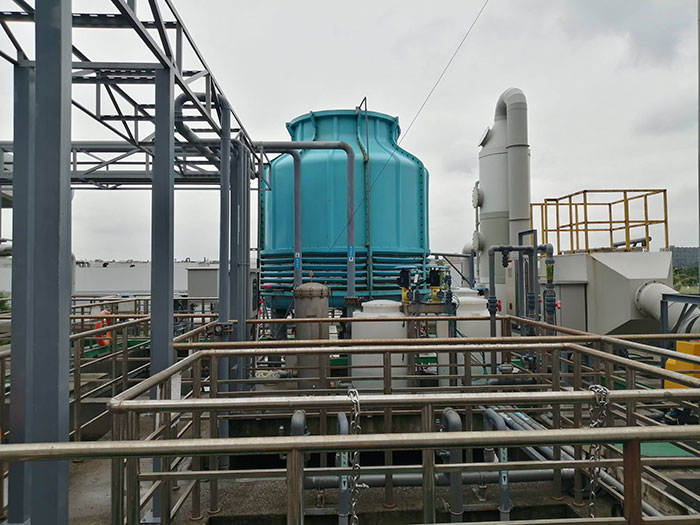
Battery recycling wastewater treatment:
Item pH CODCr NH3 TN TP F Li Fe Ca TDS
Unit - mg/L mg/L mg/L mg/L mg/L mg/L mg/L mg/L mg/L mg/L mg/L
Inlet water quality ≤2 ≤100 ≤2 ≤3000 ≤25 ≤5 ≤100 ≤20 ≤200 ≤3000
Effluent water quality 7 ≤150 ≤35 ≤45 ≤5 // // // // // // //
Important technology: High-efficiency nitrogen removal tower
Nitrogen removal efficiency of more than 95% and impact resistance
Case:
1. Lithium production wastewater treatment zero discharge project
Project Introduction: This project is to address the problem that ternary lithium batteries produce part of high-concentration wastewater during the production process and build a one-time 720T/D wastewater pre-treatment system, 200T/D MVR evaporation system, and the zero-discharge wastewater "black science and technology” can effectively improve the quality of groundwater and reduce the risk of pollution.
Wastewater type: ternary cathode material production wastewater
Treatment capacity: 720T/D
Treatment effect: COD removal rate ≥90% after pretreatment, realizing lithium sulfate resource treatment. The environmental benefits are extremely significant, and high-value metals such as lithium are recycled.

2. XXXX ternary precursor wastewater treatment zero discharge project
Project description: This treatment project is for a 50,000-ton production-scale wastewater treatment system, and the plant wastewater treatment station is a 100,000-ton scale into the planning. This system is designed according to the initial rainwater + circulating water strong drainage according to 6m³/h, workshop wastewater five m³/h, running time of 24h/d, evaporation system according to 2.5m³/h, and ultimately realize the zero-discharge wastewater.
Project scale: 250m³/d
Design principle: initial rainwater, circulating water strong drainage, workshop wastewater after pretreatment, membrane concentration system, fresh water for cooling tower circulating water use, concentrated water into the evaporation crystallization system, condensate reuse, and ultimately realize zero discharge, lithium recovery in water.