The process first filters particles and bacteria in the incoming water through an ultrafiltration membrane, and then the filtrate enters the reverse osmosis inlet tank. The ultrafiltration filtrate is used as the water source for backwashing the ultrafiltration stack. Other pre-treatment processes, such as DAF/clarifiers/multi-media filters, are available on request.
The ultrafiltration filtrate is pumped to the reverse osmosis high-pressure pump, and the freshwater is pressurized through the membrane and sent to the reverse osmosis product tank, while the concentrated water is discharged after the energy recovery device recovers the energy. The reverse osmosis product water is used as the water source for flushing the reverse osmosis stack.
The RO product water is then sent to a remineralization system (calcite filter) to add calcium and bicarbonate to meet drinking water standards.
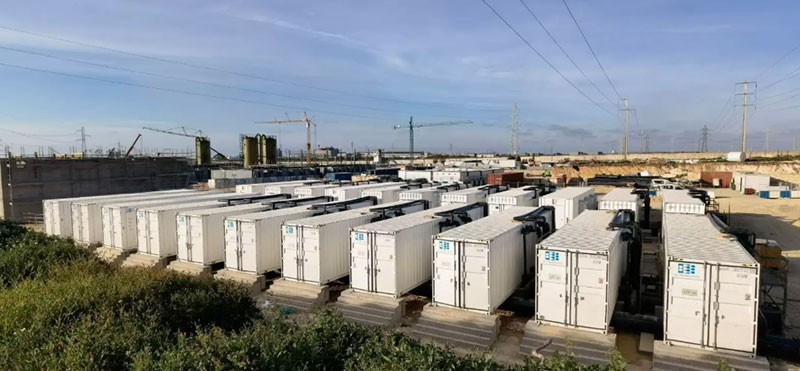
Our Solutions:
1. A large containerized desalination plant with main equipment components installed in independent containers has a freshwater production capacity of 5,000 to 20,000 cubic meters per day (5-20MLD).
- Rapid construction: Save over 50% of total construction time (compared to traditional systems)
- Rapid construction: container-type design, saving construction construction
- Rapid construction: quickly build water tanks and save concrete water tank construction
- RO complete solutions: Provide water intake advice, seawater desalination and remineralization solutions, and water distribution pumping stations.
- Plug and play: Modular design, adding four containers can produce another 5,000 cubic meters daily.
Cost savings: Save more than 60% of installation costs and more than 30% of civil construction costs (compared to traditional systems).
- Long service life I: Well-known brand, the pump, energy recovery device, and high-pressure pipelines are made of corrosion-resistant super duplex steel, the pipelines are made of UPVC/HDPE, and the frames and containers are made of heavy-duty anti-corrosion marine paint.
- Long service life II: The durable UF membrane ensures the safety of the RO high-pressure pump, energy recovery device, and RO membrane and extends the service life.
- Low energy consumption: using a high-efficiency low-pressure pump (>80%), a high-efficiency high-pressure pump (>90%), a high-efficiency energy recovery device (>95%), and a low-energy RO membrane (>5%).
- Easy to operate: PC control and cloud monitoring.
Applications: Municipal and Industrial
2. Containerized RO (reverse osmosis) systems for indoor and outdoor use. All desalination components, including piping and control systems, are pre-assembled within 1 to 2 containers, greatly reducing the on-site installation effort and time required to produce fresh water efficiently. The system is designed and manufactured to comply with ASME, ASTM, IEC, and other internationally recognized industry standards. The fastROC’s freshwater production ranges from 50 to 2,000 m3/day.
Widely used
- Construction site
- Factory facilities
- Hotels and resorts
- Other customized applications
3. Saltwater RO system
Most components are installed in 1 or 2 containers with fresh water capacities from 100 to 2,000 m3/day (4,080-83,270 l/h).
- Island residents
- Agricultural development
- Towns and small cities
- Hotels and resorts
- Golf course
- Power plant
- Mining operations
- Cooling tower
- Other customized applications